Join our zero2eight Substack community for more discussion about the latest news in early care and education. Sign up now.
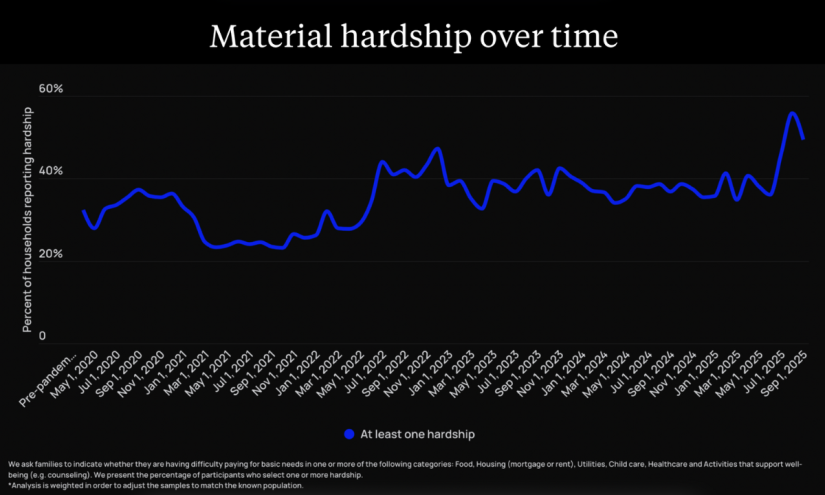
Nearly half of American families with children under 6 are struggling to meet at least one basic need, according to new data from the Stanford Center on Early Childhood.
The 49% of families who reported not being able to access these necessities — including food, housing, utilities and child care — marks a 13 percentage-point jump since June and one of the highest rates recorded since the RAPID Survey Project began collecting data in 2020.
The economic struggles were paired with significant emotional distress among parents, including anxiety and depression.
“We’re really seeing for the first time rates that are this high,” said Philip Fisher, director of the early childhood center, which runs the monthly data collection. “Never — even during the midst of the pandemic — have we seen anything like this … And the fact that it’s now going into its third month where we see rates around this high suggests that it’s not a one-time anomaly.”
The numbers are a warning sign for the state of families’ financial well-being writ large, he noted.
“We’re talking about half of families now that are saying, ‘I can’t afford child care,’ or ‘I’m skipping meals in order to feed my kids,’” he added. “And that should be of concern, regardless of your political affiliation or where you live.”

While the latest data is from Sept. 1, more detailed research is available for the month of July. In response to open-ended questions posed that month, parents expressed significant anxiety and upset.
“Every bill feels heavier than the last,” wrote one Tennessee parent. “It’s exhausting to live like this. We’re not asking for luxury, we just want to be able to meet our basic needs without constant fear.”
“A huge portion of our monthly budget goes just to keeping a roof over our heads, leaving very little for savings, groceries, transportation, or emergencies,” said one Florida parent. “The pressure to stay housed is constant, and it forces tough trade-offs, sometimes delaying bills, cutting back on essentials, or skipping activities for the kids.”
An Oklahoma parent cited the cost of baby diapers and formula as their biggest concern, while another in Alabama wrote about the rising cost of utilities.
The three-month period between June and September marked the highest rates of material hardship for parents since the survey’s inception, with a record 56% reporting at least one basic necessity being out of reach or difficult to access in August. Since the pandemic started, at least a quarter of families have reported living with this challenge every month.
The spring and summer of 2021 saw a drop in these rates. Fisher said this coincided with the majority of the pandemic relief efforts, including the expanded Child Tax Credit, which increased the maximum credit amount, widened the scope of coverage to include 17-year- olds and allowed some people to receive monthly advance payments. The expansion was credited with cutting child poverty rates nearly in half.
The One Big Beautiful Bill Act approved by Congress and signed by President Trump this summer increased the maximum credit amount by $200, though it also cuts other benefits for lower-income families.
The most recent survey numbers were recorded before the ongoing government shutdown began earlier this month, which experts warn will likely exacerbate the pain families were already feeling. Advocates are particularly concerned about programs such as Head Start, the Special Supplemental Nutrition Program for Women, Infants, and Children, also known as WIC, and the Supplemental Nutrition Assistance Program, also known as SNAP, all of which may be at risk if the shutdown continues.
Several states have already warned that families may lose access to SNAP and funding for 65,000 Head Start seats is in jeopardy if the three-week-old shutdown drags into November.
And even once the government re-opens, many of these challenges will persist, according to Amy Matsui, vice president of Income Security and Child Care at the National Women’s Law Center.
“Between the ongoing increase in housing costs and the cost of living, the aggravating impact of tariff policies, we really are seeing everyday costs for families continuing to increase, and it’s really putting women and children in an impossible situation,” she said.
Matsui also emphasized the extraordinary cost of child care, noting that this administration’s “sustained attacks” on programs such as Head Start have only added to this stressor.
Fisher warned that high levels of fiscal strain among parents can lead to a “chain reaction of hardship,” which ultimately trickles down to kids.
Indeed in July, about 3 in 4 parents surveyed said their kids were also experiencing emotional distress. Chronic anxiety in kids can have long-term effects on their learning, relationships and health.
“We know uncertainty and instability for families is very destabilizing and very, very stressful, particularly with young children,” said Ruth Friedman, senior fellow at The Century Foundation and former director of the Department of Health and Human Services Office of Child Care.
“If parents’ economic conditions are uncertain and more challenging,” she added, “that absolutely has an impact on children’s development and well-being both in the short term, and beyond.”
Did you use this article in your work?
We’d love to hear how The 74’s reporting is helping educators, researchers, and policymakers. Tell us how