This article is an on-site version of our FirstFT newsletter. Subscribers can sign up to our Asia, Europe/Africa or Americas edition to get the newsletter delivered every weekday morning. Explore all of our newsletters here
Good morning, happy Friday. In today’s newsletter:
-
US-Canada trade talks thrown into crisis
-
China’s overseas lending soars
-
A deep dive into the making of Trump’s new world order
-
And can Fidelity retain its grip on America’s investments?
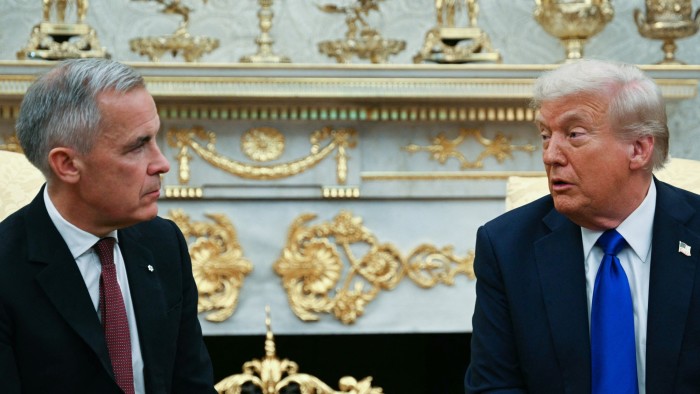
President Donald Trump said last night he had ended trade talks with Canada in retaliation for an anti-tariff advertising campaign launched by the province of Ontario. Here’s what we know.
Why did Trump announce the move? In a Truth Social post the US president said Ontario had misused the voice of former American president Ronald Reagan in an advert to speak “negatively about tariffs”.
Doug Ford, Ontario’s premier, had been championing the ads, which feature a radio address from former president Ronald Reagan in 1987, where he describes tariffs as detrimental to the US economy in the long term. Ford launched the television advertising campaign in the US targeting Republican voters earlier this month.
In a statement posted on X, the Ronald Reagan Presidential Foundation said the Ontario ad “misrepresents” Reagan’s audio address and complained the province did not “seek nor receive permission” to use the remarks. The organisation added that it was “reviewing its legal options in this matter”.
Why it matters: The move follows months of painstaking work by Canadian Prime Minister Mark Carney to improve relations with the US president. He flew to Washington earlier this month to mend fractious bilateral relations and rescue a $1.3tn trading relationship that has been threatened by a raft of US tariffs.
Trump has hit Canada with devastating levies on the steel, aluminium and lumber industries that are highly integrated in cross-border trade. He has also imposed tariffs on automobiles. Carney said this week that Canada would double non-US exports by 2035.
“We won’t transform our economy easily or in a few months,” he said in a national television address on Wednesday. “It will take some sacrifices and it will take some time.” Read the full story.
Here’s what else we’re keeping tabs on today and over the weekend:
-
US-China trade talks: US Treasury secretary Scott Bessent and trade representative Jamieson Greer meet Chinese vice-premier He Lifeng in Kuala Lumpur for talks. The negotiations come ahead of an Asean summit in the Malaysian capital on Sunday — with US President Donald Trump expected to attend.
-
Economic data: Despite the US government shutdown, the Bureau of Labor Statistics will publish September’s consumer inflation report. Separately, S&P Global publishes its flash manufacturing and services purchasing managers’ indices for October. Brazil’s consumer price data is also published.
-
Argentina elections: Javier Milei faces a defining moment as voters go to the polls in midterm elections on Sunday. Half of Argentina’s lower chamber seats, as well as a third of the Senate, are up for grabs.
How well did you keep up with the news this week? Take our quiz.
Five more top stories
1. EU leaders meeting in Brussels yesterday failed to back a €140bn loan to Kyiv using frozen Russian state assets following opposition from Belgium. The leaders of 26 countries — Hungary abstained — discussed using cash arising from about €190bn in frozen sovereign Russian assets to fund a “reparations loan” for Kyiv. Read more on why agreement was not reached.
2. China’s overseas renminbi lending is soaring, as Beijing steps up its efforts to expand the currency’s role in international finance and reduce the country’s exposure to the US dollar. Officials have focused their efforts on boosting the renminbi’s role in trade, partly as a defence against policies enacted in the US and elsewhere that weaponise the dollar. Here’s more on the expansion of renminbi-denominated credit.
3. Big pension funds are scooping up private equity professionals seeking refuge from a downturn in the sector that has restricted the carried interest payments that traditionally made up most of their pay. Tougher fundraising conditions have led to lower revenue streams for buyout firms from management fees, leaving them with less cash to hire talent. “We are finding it easier to attract talent,” said the chief investment officer at one pension fund.
4. Blackstone-backed Merlin Entertainments is under strain ahead of a critical refinancing. The Legoland-owner’s weak performance has led to a sell-off in its bonds and heightened fears over a potential restructuring. Merlin, which also owns Madame Tussauds and the London Eye, was downgraded this week by the Moody’s rating agency just two months after S&P did the same thing.
5. Anthropic has agreed to secure access to 1mn Google Cloud chips to train and run its artificial intelligence models, increasing its ties to one of its largest investors. The agreement follows a flurry of deals by Anthropic’s chief rival OpenAI to secure chips and computing capacity from Nvidia, AMD, Broadcom, Oracle and Google, estimated to be worth about $1.5tn. Read details of the Anthropic deal.
Today’s big read

Any effort to capture the scope of the opening phase of Donald Trump’s second term in office is prone to lose its bearings. The overload is intentional, writes Edward Luce as the first anniversary of the president’s re-election approaches. He spoke to dozens of figures, including lawmakers, private sector executives, retired senior military figures and intelligence chiefs, current and former Trump officials, Washington lawyers and foreign government officials for this magazine piece. What he found was a supreme leader who has cowered opponents and is on his way to building a new world order.
We’re also reading . . .
-
Argentina: The Trump administration’s bid to ‘make Argentina great again’ could badly backfire, writes Gillian Tett.
-
‘Wellness’ boom: Supplement manufacturers in the US are positioning themselves to exploit the Trump administration’s openness to fringe science.
-
Life expectancy: A concerning rise in middle-aged mortality is offsetting declining death rates among the elderly. John Burn-Murdoch investigates.
-
‘Gunboat diplomacy’: Donald Trump’s deployment of a large military force off the coast of Venezuela is reviving memories of earlier US interventions in Latin America.
Chart of the day

Fidelity Investments’ size has given it a presence in the lives of millions of Americans that rivals simply cannot match and its innovation has helped the Boston-based family-run group navigate the shift to passive investing. But despite its size and reach, new challenges are looming for one of the world’s largest asset managers. Can Fidelity keep its grip on America’s investments?
Take a break from the news . . .
In The Mastermind, Josh O’Connor plays a former art student, married with two young sons, who is failing to get his career off the ground. He is planning instead to pull off an art robbery, but the heist is just the starting point for this film about things going awry in Nixon-era America.